





The problem? Students struggle with written responses. You ask a thoughtful question about a text. You wait. You collect papers. And then you see it: She was sad. I liked the story. It was a good ending.
That’s it. No explanation. No evidence. No connection to the text.
If this sounds familiar, you’re not a bad teacher. And your students aren’t necessarily lazy. They just need a clear structure for how to turn their thoughts into a strong written response.
Most students know the answer in their head, but just struggle to show it clearly in their writing.
The Solution: RACES strategy in writing is the fix you didn’t know you needed!
RACES writing is a simple, repeatable framework that teaches students how to build a complete written response step by step.
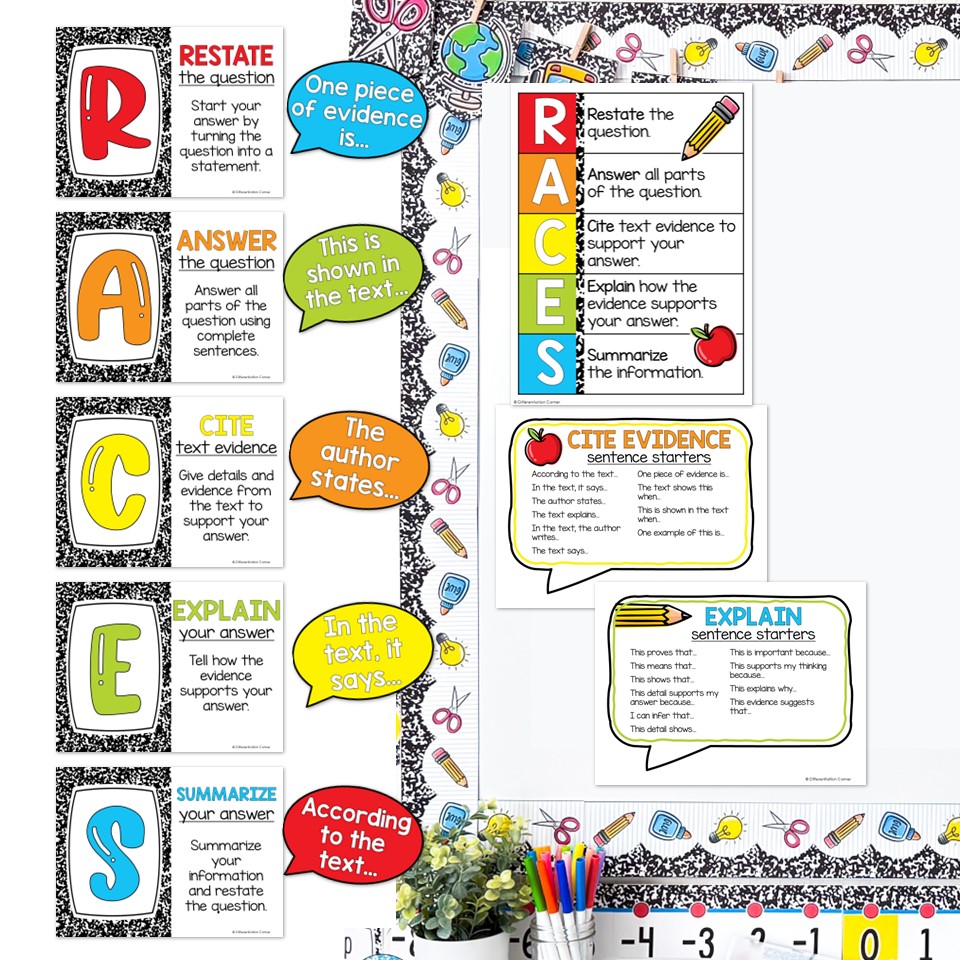
RACES stands for:
- R – Restate the question
- A – Answer the question
- C – Cite evidence from the text
- E – Explain the evidence
- S – Summarize
Why the RACES Strategy in Writing Actually Works
The reason the RACES writing strategy works is so simple. It breaks down a complex skill into manageable steps so students can actually focus on the content.
Writing a constructed response is hard. Following five clear steps? Much more doable!
RACES helps my students organize their thinking, stay on topic, use text evidence, explain instead of repeating, and end with a clear conclusion.
It helps teachers, too! It creates a consistent structure you can reference during instruction, writing conferences, and grading.
Instead of saying, “Add more detail,” you can say, “Your evidence is strong, but your explanation needs some work.”
That kind of clarity changes everything!
How to Teach Each Part of the RACES Strategy in Writing
R – Restate the Question
My students often jumped straight to answering the question without setting up their response. We have to teach them to turn the question into a statement. This one takes some practice!
Example:
Question: Why did the character leave the village?
Restate: The character left the village because…
Teaching Tip: Practice restating questions orally before writing. This builds confidence and fluency.
A – Answer the Question
This is where students clearly state their answer. Not vaguely, not halfway. This step was the easiest for my students.
Example: The character left the village because he wanted to find a safer place to live.
Teaching Tip: Remind students that this is their main idea. If someone only read this sentence, they should understand their answer.
C – Cite Evidence
This is where students prove their answer using details from the text.
Example: In the story, the author says, “The storms destroyed every home in the village.”
Teaching Tip: Model how to quote or paraphrase the text. Many students think evidence means copying the text exactly. Explicit modeling is the key.
E – Explain the Evidence
This is the step my students seem to struggle with the most. Citing the evidence alone isn’t enough. Students have to explain why it matters. My students struggled with this. They thought the reader would assume what they were implying by citing the text.
Example: This shows that the village was no longer safe, which explains why the character decided to leave.
Teaching Tip: I tell my students to ask themselves: “How does this evidence prove my answer?”
S – Summarize
Students wrap up their response with a final statement that connects back to the question.
Example: In conclusion, the character left the village because it was destroyed by the storms and unsafe now.
Teaching Tip: Keep this step simple. One strong sentence is plenty!
The Secret to Making the RACES Strategy in Writing Stick
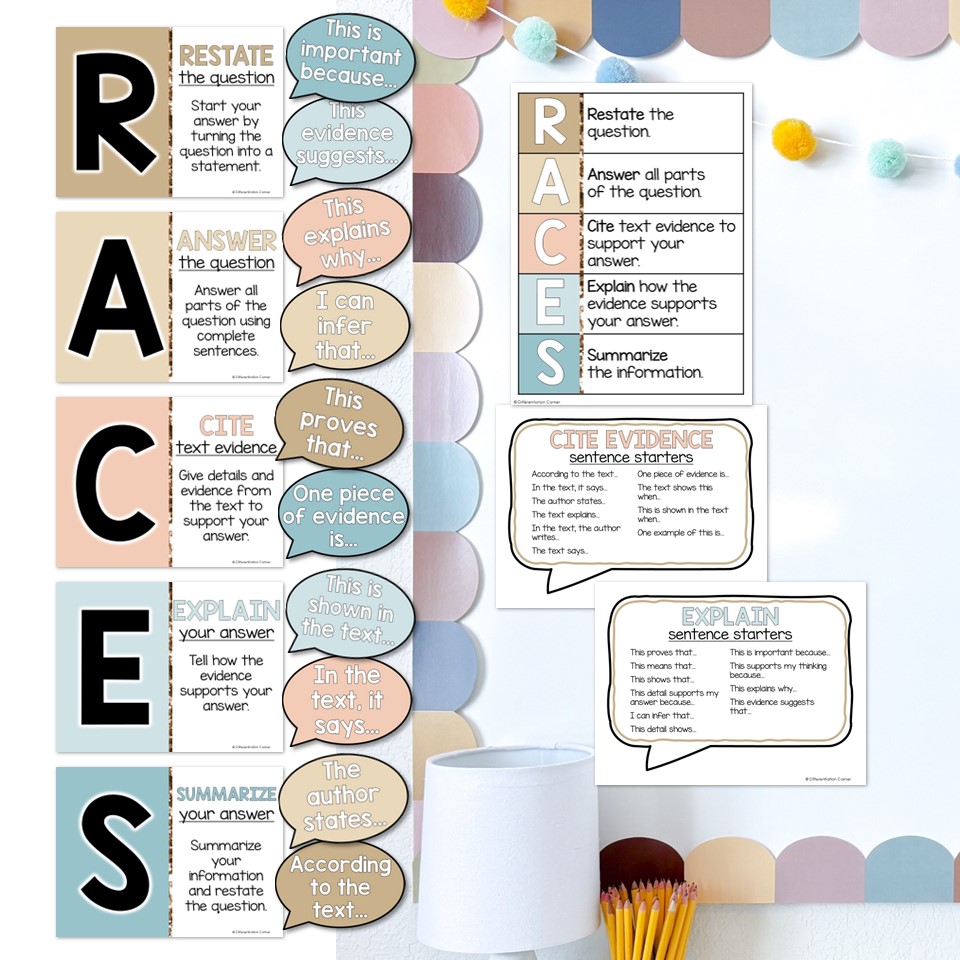
Here’s the truth: Students won’t use the RACES strategy in writing consistently unless they see it every day. That’s why visual reminders matter.
When RACES is displayed clearly in your classroom, students:
- Remember the steps
- Write more independently
- Ask fewer “What do I do next?” questions
And you spend less time reteaching and more time teaching content.
Ready to Make RACES Strategy in Writing Easy for Your Students?
If you want your students to stop writing one word answers and start crafting strong written responses, visuals are your best friend.
I created these RACES writing anchor charts sets here.
Each set has
- 2 pages of teacher tips for teaching
- 1 page of sample questions to work through with your students during instruction
- 3 sizes of anchor charts
- 10 speech bubbles with sentence starters
- Posters with sentence starters for “cite your evidence” and “explain.”
- Student bookmarks
- Editable template
Your students will finally have a roadmap for writing. And you’ll finally have fewer one sentence answers to grade!
Read more about how I use writing anchor charts in my classroom here.
Want to teach the Show Don’t Tell writing strategy and grab some free writing anchor charts? This is the blog post for you!
Here are my tips for teaching Dialogue Punctuation, Narrative, and Descriptive writing.