





If you’ve ever watched a student hold a protractor upside down and confidently announce, “It’s 32 degrees!” Welcome. You’re in good company.
The good news is that angles don’t have to be confusing. When you lean in to visuals and meaningful practice, (not just worksheets and crossed fingers), angles start clicking.
Let’s talk about how to teach angles in a way that actually sticks.
Start with Real Life Angles
Before protractors ever touch paper, make angles real.
Have students hunt for angles around the classroom:
- Door hinges
- Clock hands
- Corner of the whiteboard
- Scissors
- Open books
When students see that angles are everywhere, they stop thinking of them as a weird math drawing.
You can even turn this into a quick challenge. Let students draw or snap a picture of angles they find at home and share them the next day. Seeing and noticing angles outside the classroom is the icing on the cake for getting angles to stick!
Concrete first. Abstract later. Every concept.

Build Angles with Manipulatives
Before measuring, let them build angles with popsicle sticks, straws, paper strips with brads, or geoboards.
When students physically engage in creating angles, they see how changing the ray changes the size. They notice that the vertex stays fixed while the rays move. Seeing patterns like this in real time strengthens understanding more than passive watching ever could.
Hands on experience builds understanding way faster than jumping into a worksheet and one of my favorite ways to teach angles.
Teach Angles as a Turn, Not a Shape
This is huge. Students often think that angles are just a pointy corner. But in reality, an angle is really two rays and the space between them. The amount of turn.
Have students use their arms and rotate an arm to make the angle larger or smaller, or a paper plate spinner with a brad in the middle for showing increasing and decreasing angle sizes. Another good way to demonstrate this is by clock hands moving. Hopefully, you have a second hand for those kids with a short attention span!
Use Clear Anchor Charts for Visual Reminders
Clear diagrams help more. Students need to see it over and over. Vocabulary confusion can wreck this unit fast.
Your anchor charts should clearly show:
- Angles definition with examples and non-examples
- Vocabulary: vertex & rays
- Different types of angles: acute, obtuse, right, & straight
- How to use a protractor
Keep these anchor charts up all unit long and refer back to them constantly. The more you model using the correct vocabulary in context, the more students will start naturally using it too.
I even print out mini anchor charts for students to keep in their math notebooks for centers or independent work.
Benchmark Angles
My most important tip for how to teach angles is to emphasize those benchmark angles! They become mental reference points for estimating all other angles. If students instantly recognize 90°, 180°, & 360°, everything else becomes so much easier.
Ask questions like, “Is this angle more or less than 90°? Is it close to 180°?
Benchmark angles anchor their thinking. They stop random guessing and start using reasoning.
Model Protractor Use Slowly (Like Painfully Slowly)
Don’t rush this step because it feels procedural. This is where it all falls apart and long term misunderstandings are born. A few minutes of guided practice here saves you so much time reteaching later.
Teach the steps clearly:
- Line up the baseline with one ray
- Make sure the center dot is on the vertex
- Identify the correct zero
- Read the correct scale (here’s where using benchmark angles comes in handy)
Project a large protractor on the whiteboard and measure angles as a class. Measure SO many angles.
Show common mistakes like starting at the wrong zero, measuring the outside instead of the inside, not aligning the vertex. Teach them how to check if their answer is reasonable by thinking about those benchmark angles.
Bringing It All Together in Your Classroom
If you’re going to teach angles this year, here’s your game plan.
- Start with real angles students can physically see.
- Build angles that students can manipulate.
- Reinforce vocabulary and skills with clear visuals and modeling.
- Model measuring angles carefully and thoroughly.
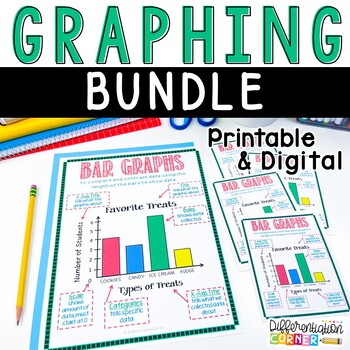
A strong set of angle anchor charts paired with meaningful practice activities makes a huge difference. When students can reference clear visuals and immediately apply what they see, the learning sticks.
If you’re looking for something that ties all of this together without you having to build it from scratch, I have a set of angle anchor charts and activities that does exactly that. It walks students through measuring with a protractor, classifying the different types of angles, and finding missing angle measurements. All with clear anchor charts!
My favorite part is the set of Google Slides with moveable protractors. I use these to model lining up the angle to measure and then assign in Google Classroom so students can practice measuring angles anywhere!
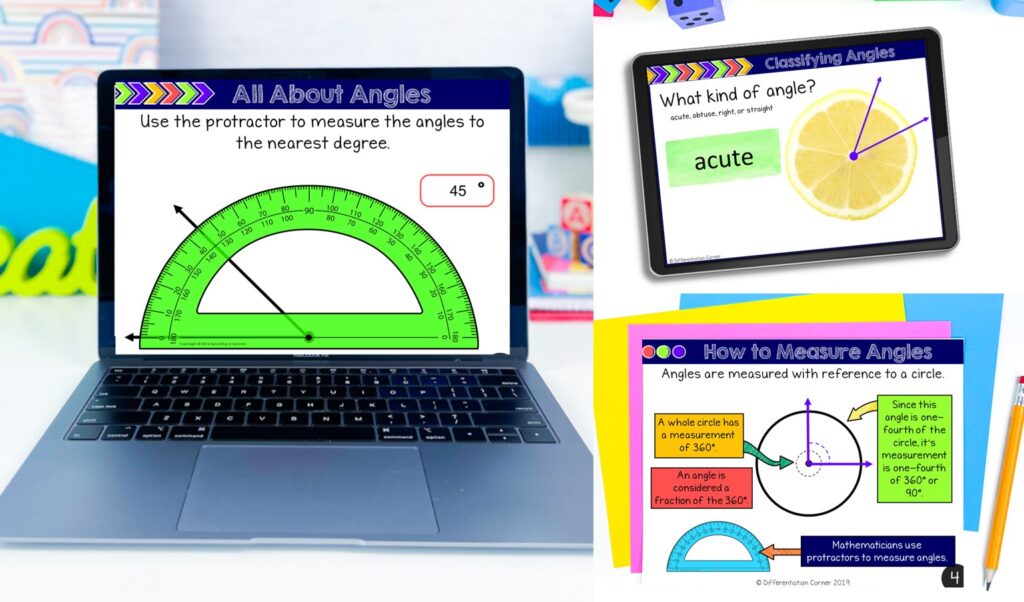
There are 94 student centered slides included for meaningful practice that are great for math centers, independent work, or even sub plans. It’s aligned to Common Core Standards and keeps the visuals strong while giving students the kind of repetition that actually builds confidence.