






There’s something so satisfying about a freshly organized classroom at the beginning of the school year.
The bins are labeled. The papers are stacked neatly. Every marker has a home. Your teacher desk is actually visible.
And then school starts.
Within five minutes, the papers begin multiplying. Parent notes appear in random places. Student work is covering your desk. Meeting notes get shoved into a folder you swear you’ll organize later.
And suddenly you have piles and piles all over your room.
Thankfully, classroom organization isn’t always an elaborate, Pinterest-worthy system with 28 matching containers.
A few simple systems can make a huge difference.
Here are five areas worth organizing early so you spend less time searching for papers and more time actually teaching.
1. Create a Simple System for Student Papers
Student work papers are probably one of the fastest ways my classroom clutter gets out of control.
You need a place for:
- Papers waiting to be graded
- Papers that are already graded
- Unfinished work
- Papers that need to go home
Give each of those categories a designated spot. Stacking trays, baskets, folders, or magazine holders all work great. You don’t need anything fancy. The important part is that both you and your students know exactly where papers belong.
2. Give Parent Communication A Home
Parent communication creates its own mess. Permission slips. Notes from home. Newsletters. Copies of emails. Conference information. Transportation changes.
Some of these need to be handled immediately. Others need to be saved for later.
Instead of letting them create a giant pile on your desk, create one central place for parent communication.
A 3 ring binder works really well for this.
You can create sections for things like:
- Parent contact info
- Communication logs
- Conference notes
- Copies of important letters
- School forms
- Student info
- Transportation info
Binder covers and dividers can also make it much quicker to easily grab the right information when you need it.
This is one of my favorite classroom organization systems. It doesn’t look exciting, but it saves me a ridiculous amount of time. Because digging through 5 piles of paper while someone is waiting for an answer is not a relaxing teacher moment.
3. Organize Small Group Materials by Group or Skill
Small group instruction usually involves a lot of moving pieces.
Books. Manipulatives. Progress monitoring sheets. Flash cards. Dry erase boards and markers. Activities. Worksheets. If you’re constantly collecting materials from different places before each group, small group time can be so stressful.
Try keeping everything you need together. You can use bins, rolling carts, baskets, or folders.
I prefer to organize my materials by skill in bins.
For reading, I have bins for phonics, fluency, comprehension, vocabulary, readers theater, etc.
For math, I have bins for multiplication, fractions, place value, measurement, etc.
My groups change frequently, so this system works well for me. If your groups stay fairly consistent, a bin for each group might work better.
The goal is simple: when it’s small group time, you should be able to grab what you need without wandering around the classroom searching for supplies.

4. Create a Home for Lesson Materials You’ll Need for the Week
Ok, reality check. Sometimes it’s more like a spot for the materials I’ll need for the next day or two. And when I get it together and have the whole week? I am so impressed with myself.
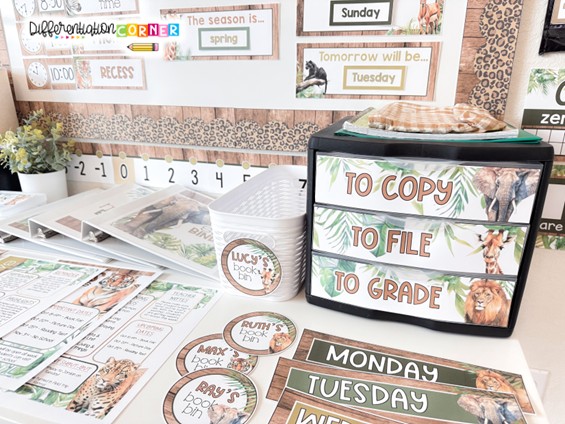
Here’s what the system looks like. You can use drawers, trays, magazine holders, folders or even labeled baskets for each day of the week.
As you’re prepping materials for the week, place your copies, task cards, activities, and worksheets into the correct day’s container. Then when Wednesday morning arrives and you’re trying to figure out where you put that science activity you copied 3 days ago, you already know where to look.
The exact setup doesn’t matter nearly as much as having a predictable system.
Labels are especially useful here because it makes it really obvious where things belong. This system is also great for when another adult needs to find materials if you have a sub, paraprofessional, or student helper.
5. Contain the Teacher Paperwork
As teachers, we have an impressive ability to collect paperwork.
Meeting agendas. Data sheets. Professional development logs and notes. Calendars. To do lists. Student info. School forms. Copies of things that we’re just supposed to have.
Without a system, all of that ends up in a huge pile behind my desk, on the floor. And once I start that pile, it grows and grows all year.
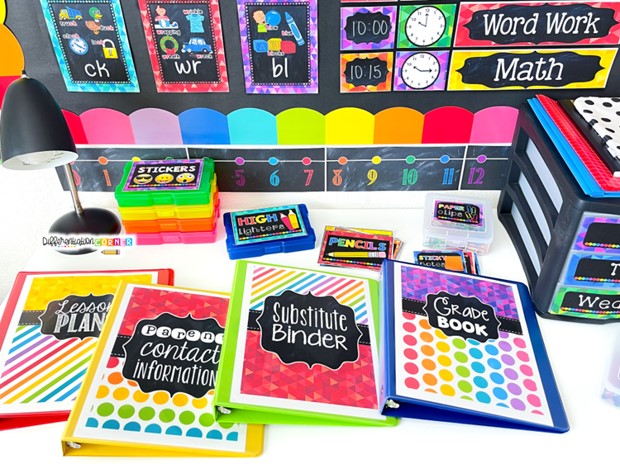
I have found that a teacher binder is one of the easiest ways to keep frequently used paperwork organized.
I have a section for:
- Calendars and schedules
- Meeting notes
- Student data
- Parent contact info
- School forms
- Professional development
- To do lists
I have a separate binder for parent communication, student data, and progress monitoring. Read all about setting up a teacher binder here or my classroom binders here.
6. Bonus Tip: Teacher Toolboxes
I use a teacher toolbox to help with all my tiny supplies that use to pile up on my desk. Like paper clips, sticky notes, index cards, binder clips, chap stick, pencil top erasers, etc.
The goal is being able to find something when you need it without digging through desk drawers. Read all about teacher toolboxes here.

Keep Your Classroom Organization Simple
The best classroom organization systems are not necessarily pretty. They’re the ones you’ll actually use.
Before buying more bins or completely reorganizing your entire classroom, pay attention to where the clutter naturally collects.
Where do students drop papers?
What ends up on your desk?
What are you constantly searching for?
Those problem areas are telling you exactly where you need a better system. Start small. Pick one area that’s driving you crazy and give it a makeover.
Then move on to the next.
You don’t need to spend your entire weekend labeling everything that you own. Sometimes it’s simply deciding where that stack of parent communication is going to live. But if you’re ready to label everything, check out this post.
If you’re ready to make your classroom a little more organized, check out my classroom organization resources like binder covers, labels, teacher toolbox labels, and rolling cart labels. All designed to help everything finally have a place to go besides your desk

Read this post: 20 Classroom Organization Hacks.