






A classroom sound wall can be a really helpful tool, but only if students actually use it.
It’s easy to spend time getting one set up, making sure everything looks right, and introducing it to your class… only to realize a few weeks later that it has basically become very educational wallpaper.
Thankfully, using a classroom sound wall during reading instruction doesn’t require a special lesson every single day. It actually works best when you weave it into phonics, decoding, spelling, and writing instruction you’re already doing.
The goal is to help students connect what they hear, what their mouths are doing, and how those sounds are represented in print.
Here are some practical ways to actually use your sound wall during reading lessons.
Refer to the Sound Wall When Introducing a New Sound
When you introduce a new phoneme, bring students’ attention to the matching sound wall card.
Say the sound together. Have students notice what their lips, tongue, and voice are doing. Then connect that sound to the letter or letters that represent it.
For example, if you’re introducing /m/, have students say the sound and notice that their lips are closed. You can also have them place their fingers on their throats and feel the vibration.
Then point out where the/m/ sound is located on the classroom sound wall and connect that sound to the letter m.
This helps students understand that the wall is there to help them think about sounds, not just decorate the reading area.
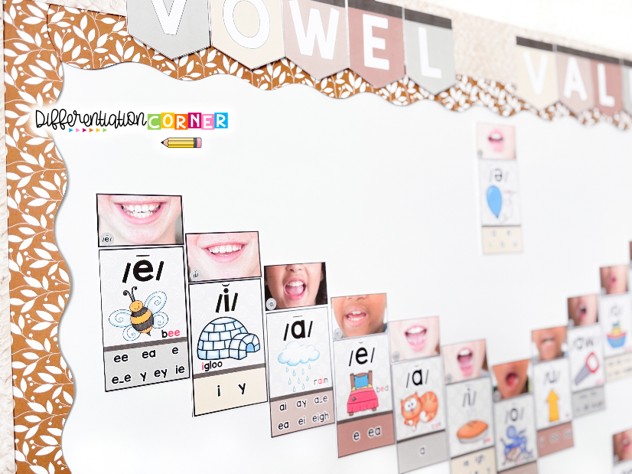
Use the Mouth Pictures to Build Phonemic Awareness
One of the most useful parts of a classroom sound wall is that it gives students another way to think about sounds besides simply hearing them.
For some students, especially those that have a hard time distinguishing similar sounds, seeing how a sound is formed can make a big difference.
You might ask questions like:
- What are your lips doing?
- Is your mouth open or closed?
- Where is your tongue?
- Can you feel your voice box vibrating?
- Which mouth picture matches the sound you’re making?
These kinds of prompts work well during phonemic awareness activities. Instead of just saying, “Listen again,” you’re giving them more clues to work with.
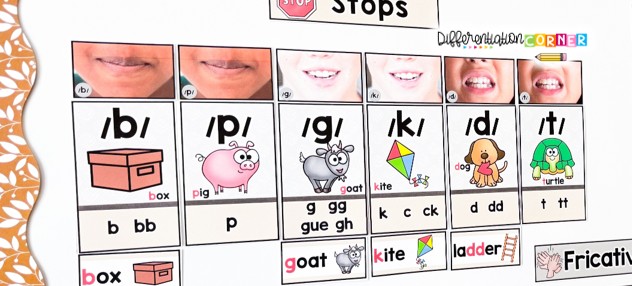
Make the Sound Wall Part of Your Phonics Lessons
A classroom sound wall fits naturally into explicit phonics instruction.
When students learn a new spelling pattern, connect it back to the phoneme they already know.
For example, students may already be familiar with the /?/ sound. As they learn different ways to spell that sound, like a_e, ai, and ay, you can revisist the/?/ section of the sound wall and add and discuss those graphemes.
This helps students see that one sound can be represented in different ways.
Instead of treating each spelling pattern like a separate piece of information, students begin connecting new grapheme connection is really where the sound wall becomes useful.
Use the Sound Wall During Blending and Decoding
The sound wall can also become a quick support when students get stuck while reading. If a student is having trouble decoding a word point them back to the wall.
You might ask:
- What sound does that spelling represent?
- Can you find that sound on the wall?
- Say the sound before you blend the word.
- What is your mouth doing when you say it?
For example, if a student is working on the word ship, you could point them toward the /sh/ sound card before having them blend /sh/ /i/ /p/.
The sound wall should not replace explicit instruction, but it can give students a visual reminder that helps get them unstuck.

Use It During Spelling and Encoding
This is my favorite use for classroom sound walls. When students are trying to spell an unfamiliar word, encourage them to start with the sounds they hear.
Have them say the word slowly, stretching it out to hear each phoneme.
Then they can use the sound wall to help connect those sounds to spelling patterns they’ve already learned.
For example, with the word chat, students can segment the word into /ch/ /a/ /t/. From there, they can use what they know about those sounds to choose the correct graphemes.
This makes the sound wall useful during dictation, word building, spelling practice, sentence writing, and independent writing.
Instead of asking, “How do you spell this?” students start asking themselves, “What sounds do I hear?”
That is a much more useful habit.
Use the Sound Wall During Word Mapping
Sound walls pair really well with phoneme-grapheme mapping.
When students map a word, they’re already focusing on the relationship between sounds and spelling.
You can have students say the word, segment the phonemes, map one sound into each sound box, and then connect each phoneme to the grapheme that represents it.
Take the word train, for example. /t/ /r/ /?/ /n/
Then they can identify that ai represents the sound /?/.
The sound wall gives them a visual place to connect that spelling pattern to the phoneme they’re hearing.
This is especially helpful for students who tend to memorize whole words visually instead of paying attention to the sounds inside them.

Encourage Students to Use It Independently
Eventually, you want students to stop seeing the classroom sound wall as something only teachers use.
They should begin using it as a reference on their own.
You can build that habit by using consistent prompts like:
- Check the sound wall.
- Find the sound you hear.
- What is your mouth doing?
- Which spelling pattern have we learned for that sound?
The more often students hear those prompts, the more likely they’re going to begin using the wall without being reminded.
Individual sound walls are great for students sitting far away from the wall, quietly working independently, or receiving intervention.
The goal is the same. You want students to have access to a tool that helps them connect sounds and spelling patterns independently.

Revisit Sounds Instead of Teaching Them Once
Your sound wall should grow with your instruction.
Students do not need to see every possible spelling pattern from the first day of school.
Instead, introduce a new sounds and graphemes as you teach them.
Then keep coming back to those sounds as students learn additional spelling patterns.
For example, students may first learn that /k/ can be represented with c or k. Later, you might introduce ck.
When that happens, return to the same phoneme and add the new spelling pattern.
This helps students understand that the sound itself hasn’t changed. They’re just learning another way that sound can appear in print.
That repeated connection is much more useful than putting everything on the wall at once and hoping students will somehow notice and absorb it.
A Sound Wall Should Be A Tool, Not Just A Display
You don’t need to stop your reading lesson every day and announce that it’s time to use the sound wall.
Instead, bring it into the instruction you’re already doing.
Point to it when introducing new phonemes. Refer back to it when teaching spelling patterns. Use it during decoding, word mapping, dictation, and writing.
Over time, students begin to see the wall as something that can actually help them solve reading and spelling problems.
The goal isn’t to have the prettiest classroom sound wall in the building, but for students to know exactly why it’s there and how to use it.
My classroom sound wall sets include real mouth photos, vowel valley cards, consonant wall cards, grapheme cards, and locks you can use to cover sounds and spelling patterns that haven’t been introduced yet.
They also include individual sound walls that can be helpful for small groups, intervention, or independent work.
Ready to dive deeper into using a sound wall? Read this post next: 10 Sound Wall Secrets